Lists with names
This is the most important idea in Tensela. Once it clicks, the rest becomes much clearer.
What for
Section titled “What for”To work with many things at once, 16 floors, 20 bays, 320 panels, without arranging the data by hand before combining it.
The idea: threads and crossings
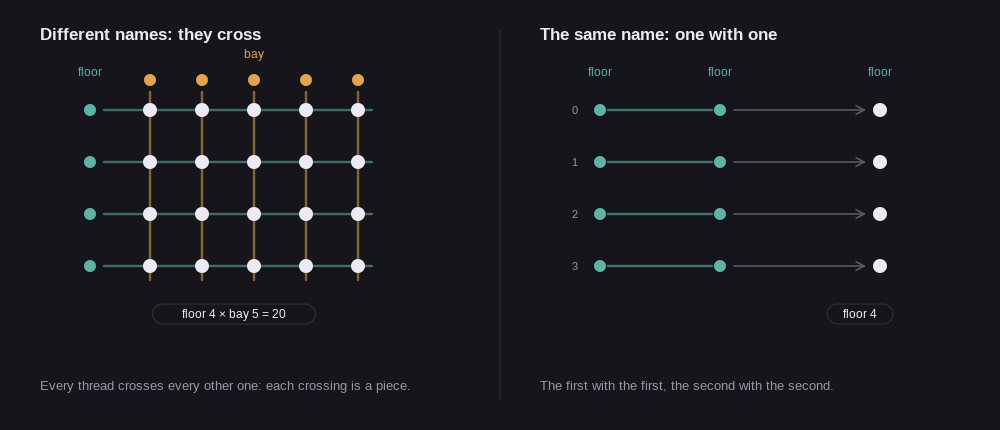
Section titled “The idea: threads and crossings”Every list in Tensela carries a name, its level: floor, bay, panel, rib. When a node receives two lists, it looks at their names:
- Different names: every one with every other one. 16 floors and 20 bays give 320 panels, like the threads of a fabric: every vertical thread crosses every horizontal one, and each crossing is a piece.
- The same name: one with one. The first with the first, the second with the second. Two lists of 16 floors give 16 results, not 256.
That is all. There is nothing to flatten, graft or transpose.
- Nodes that make lists, such as Series, Grid, Points on curve or Split, have a field to name the
level. A Series of 60 numbers named
ribmeans these 60 values are 60 ribs. - The name is free. What matters is to write it the same where you want lists to pair one with one, and different where you want them to cross.
- Tip: use the singular of what you count, rib, floor, panel, because it reads naturally: rib 3.
What it does
Section titled “What it does”- The cable shows the shape:
rib 60 × height 60 = 3 600. - Levels have no order.
floor × bayandbay × floorare the same thing. - Operations work on a level, by its name: reverse the floors, keep one bay out of two, shift the floors one up, split into groups of four. Reorder, Filter, Pick and Split ask which level, by name.
- If two lists with the same name have different sizes, a notice says so instead of guessing.
An example to try
Section titled “An example to try”Make two Series: one of 5 numbers named x and one of 5 named y, and connect them to a Point (one to x,
the other to y). You get 25 points in a square: the names are different, so they cross. Now name both x: you
get 5 points on a diagonal, because they pair one with one.
To go further
Section titled “To go further”How a list with levels is kept and combined, with code: Named lists, inside. The same tasks in Grasshopper and Dynamo: Lists in Tensela, Grasshopper and Dynamo.