
Environment brings the site into the design: where the sun is, which faces it reaches, how much light gets inside. These nodes are amber on the canvas.
Time is local standard time, without summer time. 13.5 is half past one. The time zone is the hours from
UTC without summer time: Madrid +1, Montevideo -3.
Sun and shadow
Section titled “Sun and shadow”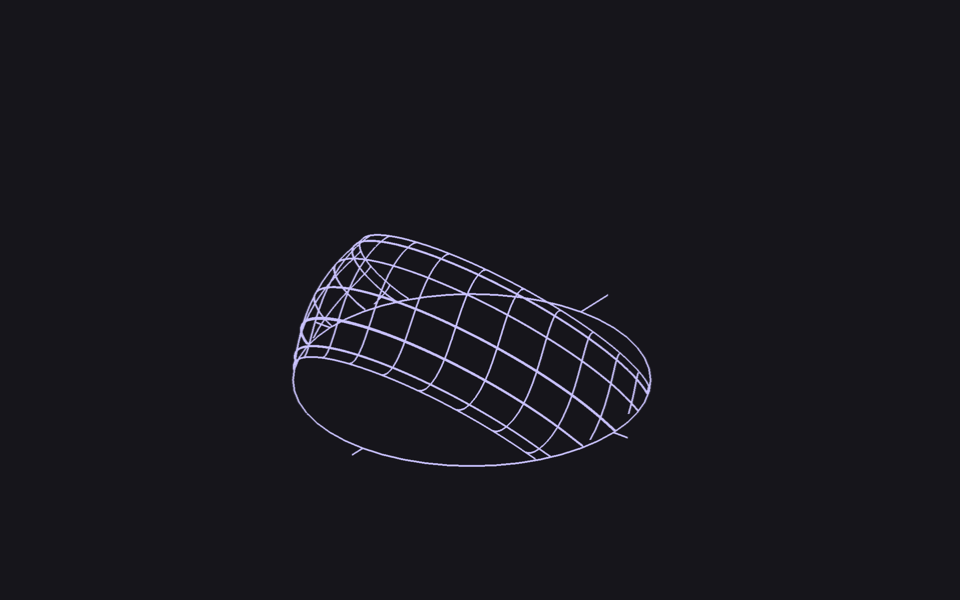
What for. Where the sun is for a place, a day and an hour, and its path: the solar diagram, the ray of light for shadows and angles, its altitude and azimuth, sunrise and sunset.
| Input | What it means |
|---|---|
| location | a city of the list, or other place to give its latitude, longitude and time zone |
| day, month, hour | the moment; each can be a list |
| scale | the radius of the diagram and the distance of the sun, in metres |
| show | the diagram, the day path, the position, a beam, the ray, the altitude, the azimuth, sunrise… |
Tips.
- The ▶ of the hour, in the panel, plays the day: shadows and angles move with it.
- For Shadow and Incidence, set show to ray.
Shadow
Section titled “Shadow”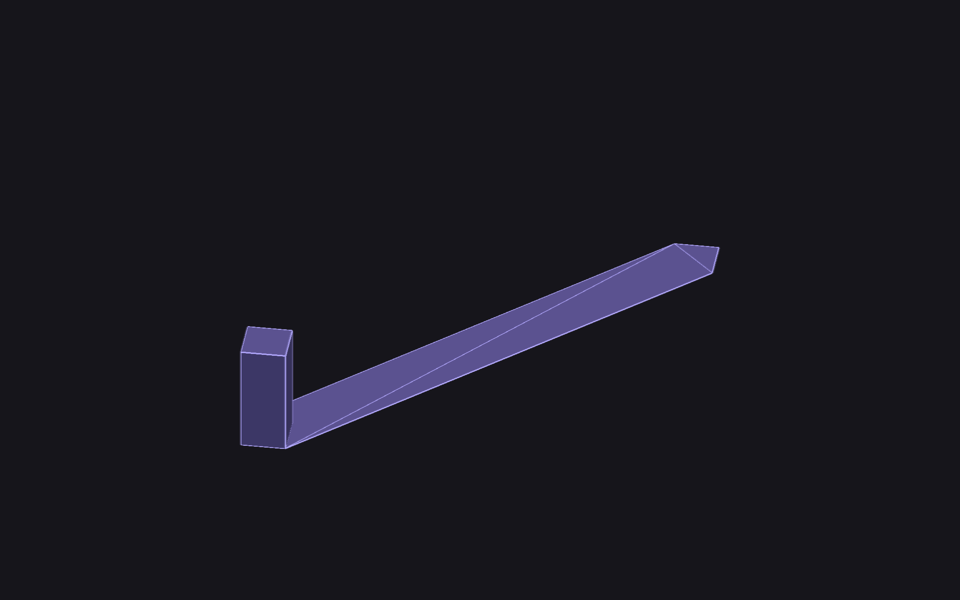
What for. The shadow of some geometry with the ray of a Sun: on the ground, exact, with its outline and its area; or on other surfaces (a terrain, a façade), face by face.
| Input | What it means |
|---|---|
| geometry | what casts the shadow |
| ray | the ray of a Sun; with a list of hours, the shadows of all of them |
| ground | the height of the ground |
| surfaces | optional: where it falls instead of the ground, face by face |
| show | the shadow, its outline, its area, or the faces sunlit or in shadow |
Incidence
Section titled “Incidence”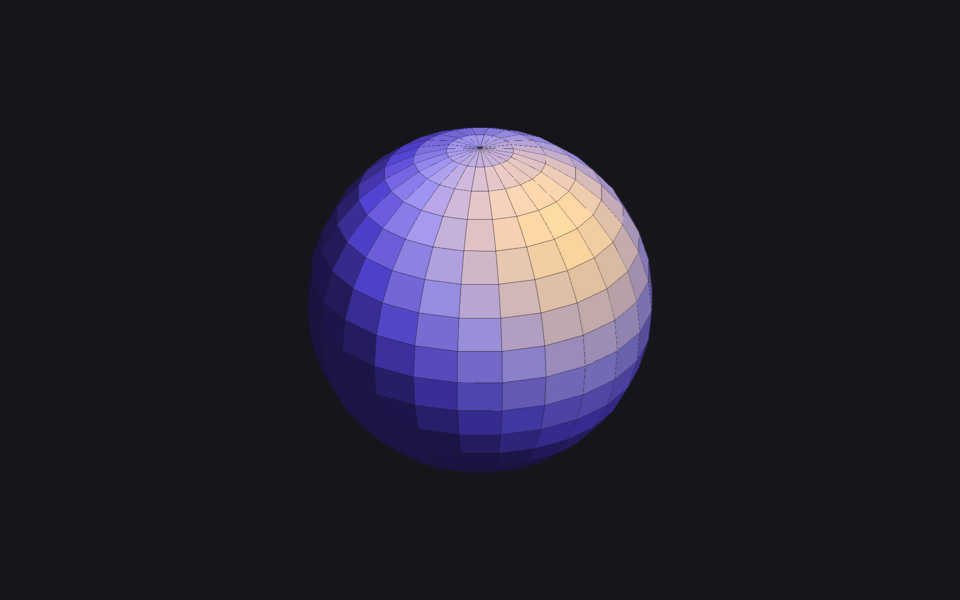
What for. How straight the sun reaches each face: 1 when it falls square, 0 when it grazes or comes from behind. For panels that open or close with the sun, or to see which side of a building gets the sun.
| Input | What it means |
|---|---|
| faces | panels, a mesh, a surface or a box |
| ray | the ray of a Sun; with a list of hours, their average |
| side | its face (where each face looks) or both faces |
| show | sunlight (1 to 0) or the angle from the face, in degrees |
Energy and light
Section titled “Energy and light”Insolation
Section titled “Insolation”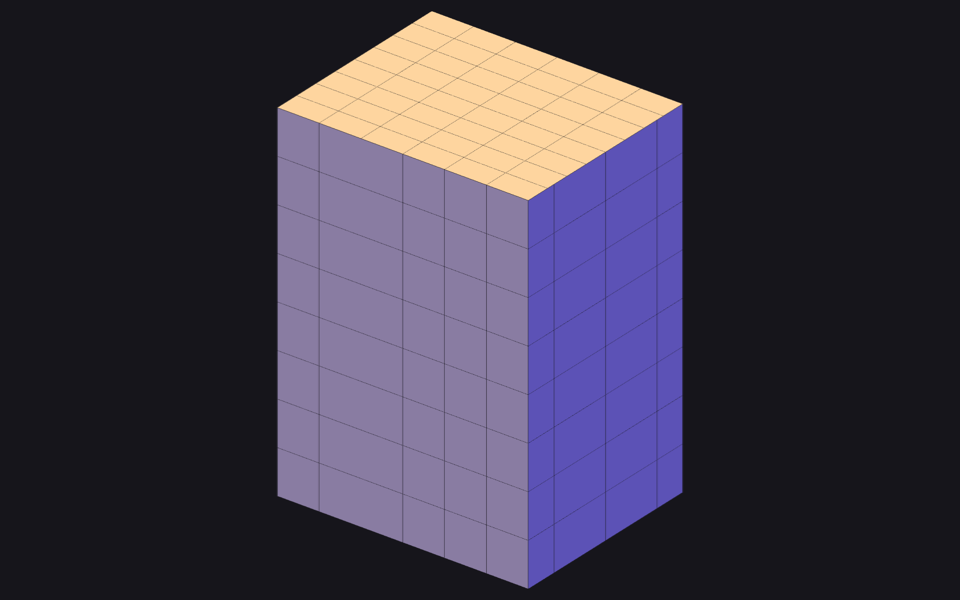
What for. The solar energy each face receives in a period, with what shades it: in kWh/m², the hours of sun, or how much sky it sees. For passive gain (much sun in winter, little in summer) and to place solar panels. An estimate for comparing options, not an energy or yield calculation.
| Input | What it means |
|---|---|
| faces | what is analysed |
| obstructions | optional: what shades it (neighbours, trees, the rest of the building) |
| climate | optional: a Climate node, for the real sun of each hour; without it, a clear sky |
| location and its latitude, longitude, time zone | the place |
| period | year, summer, winter, month or day |
| show | radiation, direct, diffuse, sun hours or sky view |
Tips.
- Paint the faces by its value (Colour → by a value) to see the result on the building.
Daylight
Section titled “Daylight”What for. How much natural light reaches some points inside a room under an overcast sky: the daylight factor, the lux, and the average and uniformity of the room. A simplified estimate for comparing options; for regulations or certification, a validated simulation.
| Input | What it means |
|---|---|
| points | where it is measured: a grid at desk height, 0.7 to 0.85 m |
| room | the room: a box, or its walls, floor and ceiling |
| glass | the windows: rectangles on the walls |
| obstructions | optional: what blocks the sky outside (louvers, eaves, neighbours) |
| transmittance | how much light the glass lets through, in % (double glazing about 70) |
| reflectance | how much light the walls reflect, in % (light walls about 70; dark, 30) |
| show | daylight factor, illuminance, sky component, average illuminance, average daylight factor or uniformity |
Tips.
- As a reference, 2 % is often taken as a well-lit room and 5 % as a very bright one.
Climate
Section titled “Climate”What for. The climate of a place from a weather file (.epw): temperature, humidity, sun and wind of each hour of
a typical year. Connected to Insolation, the real sun instead of a clear sky.
| Input | What it means |
|---|---|
| file | a weather file .epw, or the .zip it comes in (climate.onebuilding.org) |
| show | temperature, humidity, radiation, wind speed or direction, cloud cover |
| per | hour (8760), day (365) or month (12) |